When I was little, I thought that water was free. After all, it just fell from the sky as God’s gift, flowed in the streams near our house, and it was what Dad always had us order at restaurants. So, in a youthful attempt to study the geological processes of erosion, I left the spigot on the side of my parents’ house on for a few hours, watching the water carve a canyon while I built cities beside my river. I was oblivious to the growing delta of mud spreading across the driveway. When Dad came home from work the first time I did that, well, he wasn’t the happiest. But it was probably the third or fourth time that really got his goat.
Since then I’ve learned that while water should be a right it is too often a privilege and I’ve become more of a conservationist. So this morning (like many other mornings), I made several trips carrying the water from the bathtub (inside) in a bucket and dumping it in the washing machine (outside). When the washing machine is finished with it, it drains into a tub. I then use that twice-grey water to water the garden or the flowers. We also often collect the rinse water and use it for the next wash load.
But ultimately, it’s not about my paltry human efforts. “Elijah was a man just like us, and he prayed, and it didn’t rain for three years. Then he prayed again, and it rained.” It is God who can overcome patterns of drought, send rain in its season, and cause springs to well up in the land.
Lord, water the lands you have made,
and give water to thirsty ground and thirsty throats,
living water to thirsty hearts.
Te nkarna e Yesu, atoomono.
The rough draft of the Swahili adaptation / translation of our Enkinosata Ororei le Nkai (“Eating the Word of God”) curriculum has been finished. On February 16th, I went to Narok to meet with our editorial committee. We were able to work through a number of important issues. I am particularly excited because the adaptation of this project was begun at the initiative of the leaders of our CCC congregation in Narok town. It is also wonderful that my five christian brothers working on this with me represent four different tribes (Maasai, Kisii, Kamba, Meru).
L-R: Joshua, David Kamunyu (Meru), Matthew Ngomo (Kamba), Daniel ole Denkel (Maasai), Samson ole Dikirr (Maasai). Not pictured (taking the picture): Elijah Ombati (Kisii)
This curriculum has not yet been taught in the Narok congregation because, being a multi-tribal congregation, Swahili is usually used rather than Maa. But as they have gone through the material, this group of leaders has been greatly encouraged by it and are excited about the potential it has to make a great impact on the maturity and growth of the church. This is especially true as the CCC is expanding across tribal boundaries. So, let’s eat!(Mainosa – “let’s eat” in Maa; Tunakula – “we eat” in Swahili)
Speaking of eating, Alitzah and Hannah Gail really wanted to come with me on this trip. While I was in this meeting, they were at the Ombatis’ house playing with their two daughters. After the meeting, they ran errands around town with me. (One of those errands involved making arrangements with a brand new christian bookshop to distribute our Maa language materials.) At the end of a long day, they were very hungry and happy for me to take them out for a Daddy-Daughters date at their favorite “hoteli” – Kim’s Dishes – for some traditional Kenyan fare.
We had Kenyan friends over for New Year’s Eve: Kimunya & Harriet and their three children, Tinashe (girl), Tatenda (boy), Tumelo (girl). Our little princesses were glad to have two visiting princesses to play dress-up with them. (Tumelo, just 2 1/2, had gone back inside before we got out the camera.)
In our house, we’ve started listening to our Christ-mas music today. At the moment, “O Come, O Come, Emmanuel” is playing. Are we getting ahead of ourselves in the holiday schedule? No, we are focused on holy days rather than commercial rush. The old word for the Lord’s Supper or Communion is Eucharist which simply means “Thanksgiving.”
And so as “Black Friday” looms around the corner, we are thinking about Good Friday. And on Thanksgiving Day, we are thinking about Christmas. Without Jesus, we would have no reason for giving thanks.
We’ve updated our contact page. Sometimes packages sent to us to the CMF-Kenya address (PO Box 59322 / 00200 City Square / Nairobi, KENYA) have … disappeared after arriving in Kenya. So we’ve gotten our own PO Box that we can check ourselves. So if anyone wants to send us some snail mail, use this new address:
Joshua & Ruth Barron
PO Box 1197
00502 Karen
Nairobi, KENYA
East Africa
This is my favorite road sign in Kenya (so far). Duka Moja is a small village in the Rift Valley half way between nowhere and lost. (Okay, it’s actually on the REALLY, REALLY NICE new highway between Maai Mahui and Narok.) But I think it’s funny because “duka moja” is Swahili for “one shop”. So whenever I drive past this sign (fairly often the past year), I think of the segment on the old Hee Haw show: “Goosepimple Junction, we salute you!” And I laugh.
(Goosepimple Junction is a real place — “village” and “hamlet” are too large — in Southwest Virginia not far from where I grew up.)
We no longer live in the bush, so we haven’t seen any elephants, baboons, and giraffes out of kitchen window here in Narok. (Narok is a “small town” with a population of around 100,000.) We’re on the edge of the river valley, and sometimes we’ve seen some zebras several kilometers away across the river. But there are some other wildlife roaming around our house. Hundreds of bird species (many brightly colored ones; the ibis and an eagle are the largest) nest in our trees. In one side of the yard, there are hundreds of baboon spiders (think hairy tarantulas) that live in underground (thankfully!) burrows. Only one of those has ever found its way into the house. (It died a quick and sudden death).
A mongoose couple seems to be taking up residence in our yard. The girls are very excited. We are pleased. Remember the story of Rikki-Tikki-Tavi ? Mongooses mean no snakes. (Yes, the correct plural of mongoose is “mongooses”, NOT “mongeese.” We double-checked in the dictionary.) The girls would like a PET mongoose (so would I, actually), but having a pair of wild ones living around the house is a close second. … I wonder, do mongooses eat big hairy spiders?
The monkeys have been waking us up very early lately. The juvenile monkeys have taken to dancing and scampering about on our tin roof. Houses in Kenya that aren’t way out in the bush usually have cast iron security grills (often quite decorative) over the windows. The monkey babies have been climbing on the grill of the second floor windows of the girls’ room, watching them play with their toys. We have to make sure that we leave the door to the balcony-veranda off of our bedroom CLOSED or they’ll come right in and steal things. This has happened to friends of ours. Gotta keep the downstairs doors closed as well. These monkeys like nothing better than to ransack a kitchen in search of people food. But they are quite cute.
grace and peace to you all,
joshua for all of us
December 24 update: Ah, well. I suppose it couldn’t last! A monkey finally got in and ransacked our kitchen a couple of weeks ago (Dec. 15) . Lost to the monkey: 2 pounds of tomatoes, 9 large bananas, maybe 4 passion fruit, 1 mango, 1 papaya, 1 pound of butter. Somehow, the two monkeys that are playing outside of my bedroom window in a Jacaranda tree right now just don’t look as cute as they used to look. Oh, by the way, they are vervet monkeys, for those of you who want to know.


 Speaking of eating, Alitzah and Hannah Gail really wanted to come with me on this trip. While I was in this meeting, they were at the Ombatis’ house playing with their two daughters. After the meeting, they ran errands around town with me. (One of those errands involved making arrangements with a brand new christian bookshop to distribute our Maa language materials.) At the end of a long day, they were very hungry and happy for me to take them out for a Daddy-Daughters date at their favorite “hoteli” – Kim’s Dishes – for some traditional Kenyan fare.
 A new house, curriculum development, training sunday school teachers for the Maasai churches, a special visitor from America …
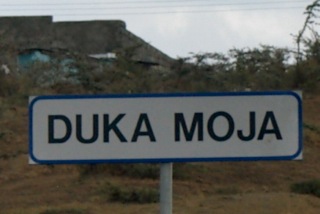 This is my favorite road sign in Kenya (so far). Duka Moja is a small village in the Rift Valley half way between nowhere and lost. (Okay, it’s actually on the REALLY, REALLY NICE new highway between Maai Mahui and Narok.) But I think it’s funny because “duka moja” is Swahili for “one shop”. So whenever I drive past this sign (fairly often the past year), I think of the segment on the old Hee Haw show: “Goosepimple Junction, we salute you!” And I laugh.