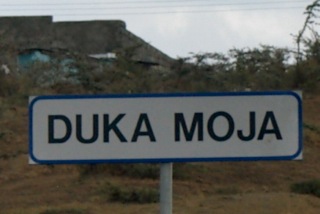
 This is my favorite road sign in Kenya (so far). Duka Moja is a small village in the Rift Valley half way between nowhere and lost. (Okay, it’s actually on the REALLY, REALLY NICE new highway between Maai Mahui and Narok.) But I think it’s funny because “duka moja” is Swahili for “one shop”. So whenever I drive past this sign (fairly often the past year), I think of the segment on the old Hee Haw show: “Goosepimple Junction, we salute you!” And I laugh.
(Goosepimple Junction is a real place — “village” and “hamlet” are too large — in Southwest Virginia not far from where I grew up.)
In 2010, the number of CCC churches in Kenya grew from 135 to 163!
(CCC is “Community Christian Church”, the name of the fellowship of congregations planted by CMF … including the daughter, grand-daughter, and great-grand-daughter churches. Currently, the CCC church planting movement is expanding among the Maasai, the Turkana, and the Samburu peoples. Note: the total of 163 does NOT include many church plants that are still in the beginning stages.)

Jackson Meing'ati with Zerachiah
Our friend and co-worker, Jackson Meing’ati, came over today to drink shaai (tea with milk and sugar, or honey, in this case) and “chew the news.” Zerachiah, who hadn’t met him yet, quickly made friends!
We discussed the implementation of the Enkinosata Ororei Le Nkai curriculum in the Maasai churches. He also told me that the Ewaso Ng’iro congregation has just recently planted two new churches! I think that brings the count of CCC congregations up to 144 among the Maasai, Turkana and Samburu (not counting numerous other church plants that are still “in progress”).
Maisisi Olaitoriani! Let us praise the Lord!
…
…

death: crucified and buried with Jesus
At church today we had seven baptisms. While the new beginning and new birth of baptism is always exciting, this baptismal service was particularly special, for two reasons. First of all, there were four different tribal groups represented: Maasai, Kikuyu, Luyha, Kisii. What a wonderful foretaste of heaven! Just three years ago, Narok was on the brink of a couple of months of terrible inter-tribal violence during the post-election crisis in 2007-08. Today, at least in this place, representatives of enemy tribes have been brought together in Christ.

new birth: raised to walk in the resurrection life of Christ our Lord
Secondly, all of those baptized were youth between the ages of 15-18. And I think without exception these youth came from member families. While it is always delightful to witness the coming to Christ of people from completely outside the Church, we have often seen faithful believers mourn that their children are not choosing to become followers of the Way. What a blessing when parents are able to share the good news with their children!
…
Of course, we must remember that as with all life, the birth is just the beginning. Pray that these new believers will grow into mature disciples of our Lord.
We no longer live in the bush, so we haven’t seen any elephants, baboons, and giraffes out of kitchen window here in Narok. (Narok is a “small town” with a population of around 100,000.) We’re on the edge of the river valley, and sometimes we’ve seen some zebras several kilometers away across the river. But there are some other wildlife roaming around our house. Hundreds of bird species (many brightly colored ones; the ibis and an eagle are the largest) nest in our trees. In one side of the yard, there are hundreds of baboon spiders (think hairy tarantulas) that live in underground (thankfully!) burrows. Only one of those has ever found its way into the house. (It died a quick and sudden death).
A mongoose couple seems to be taking up residence in our yard. The girls are very excited. We are pleased. Remember the story of Rikki-Tikki-Tavi ? Mongooses mean no snakes. (Yes, the correct plural of mongoose is “mongooses”, NOT “mongeese.” We double-checked in the dictionary.) The girls would like a PET mongoose (so would I, actually), but having a pair of wild ones living around the house is a close second. … I wonder, do mongooses eat big hairy spiders?
The monkeys have been waking us up very early lately. The juvenile monkeys have taken to dancing and scampering about on our tin roof. Houses in Kenya that aren’t way out in the bush usually have cast iron security grills (often quite decorative) over the windows. The monkey babies have been climbing on the grill of the second floor windows of the girls’ room, watching them play with their toys. We have to make sure that we leave the door to the balcony-veranda off of our bedroom CLOSED or they’ll come right in and steal things. This has happened to friends of ours. Gotta keep the downstairs doors closed as well. These monkeys like nothing better than to ransack a kitchen in search of people food. But they are quite cute.
grace and peace to you all,
joshua for all of us
December 24 update: Ah, well. I suppose it couldn’t last! A monkey finally got in and ransacked our kitchen a couple of weeks ago (Dec. 15) . Lost to the monkey: 2 pounds of tomatoes, 9 large bananas, maybe 4 passion fruit, 1 mango, 1 papaya, 1 pound of butter. Somehow, the two monkeys that are playing outside of my bedroom window in a Jacaranda tree right now just don’t look as cute as they used to look. Oh, by the way, they are vervet monkeys, for those of you who want to know.