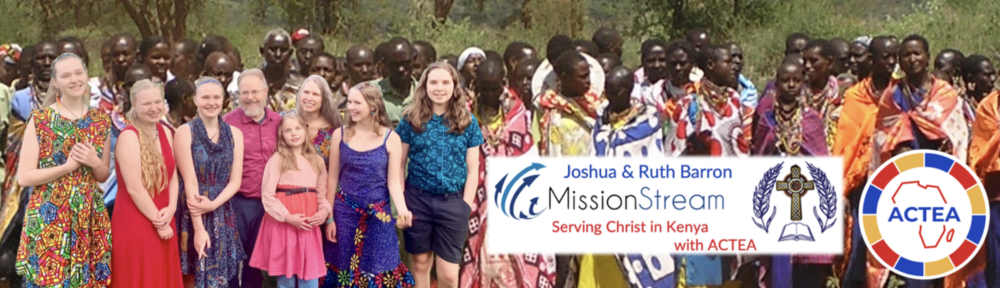
Cross-cultural life & work are exhilarating. Asking what it means, practically speaking, to live with Jesus from the view point of a different language and culture can open your eyes to the teachings of Scripture in new and profound ways. We have found this to be especially true as we have struggled with culturally relevant and biblically faithful ways to teach stewardship.
In many western contexts, teaching on stewardship can be summarized like this:
That stuff you think you own? It’s not really yours; it’s God’s. So treat “your” resources accordingly.
This approach captures part – but not all – of the biblical teaching on stewardship. But in East African contexts, as soon as you say “it’s not really yours” you’ve lost your audience and thrown in the towel. The Maasai have a proverb that explains this: The cow says, “don’t lend me. Just give me away.” This is because the cow knows that if it is lent, it will not be well cared for. Only when there is ownership is there also proper stewardship. We also see this in the teaching of Jesus in John 10.12-13.
The hired hand, who is not a shepherd and does not own the sheep, sees the wolf coming and abandons the sheep and flees. So the wolf attacks the sheep and scatters them. He runs away because he is only a hired hand and has no concern for the sheep.
Only when you can say “it is mine” or “it is ours” can stewardship be faithfully practiced. There is another Maasai proverb that emphasizes this: All things which their owners care for endure. The twofold implication (which is clear in the Maa) is that only owners properly care for possessions and only proper stewardship enables things to last.
There is a place to teach that stewardship is the management of someone else’s resources. (See, for example, Matthew 25.14-3.) But it is also necessary to recognize we are the recipients of God’s gifts. What God has given you is now yours.
ORE TINIATA MENYE, MIMURATA
Another Maasai cultural proverb suggests an alternative approach to the traditional western interpretation. Now if you have a father, it observes, you’re not really circumcised. For many tribes in East Africa, including the Maasai, boys are ritually circumcised during adolescence. This event marks a major transition. No longer a boy, the circumcised male is now a warrior and a man. So the proverb is saying that if your father is still alive, it is as if you are still a boy. Culturally, if your father is alive, it’s as though you are still a youth.
Why is this? Because you show natural respect for your old father. You honor him by consulting with him before you so much as a sell a goat to obtain school fees for your children. Are you 60 and a grandfather? If your dad is still alive, you will consult with him before you sell a goat to obtain school fees for your grandchildren.
Traditionally this is NOT abusive patriarchy. It is not just that the old man remains the nominal head of the extended family. Rather, he is recognized to have wisdom. He can guide the younger generations in the best way forward. Being past the point of self-seeking desire, he has a broader perspective about what is best for the whole family. The primary interest of the old man is in the well-being of his whole family. So he will advise them accordingly. He receives enkanyit (proper respect and honor) and gives in return counsel and blessing.
(Western cultures used to practice something similar. We called it “filial piety.”)
For those of us who follow Jesus, we know that our Father Papa God is alive. This does not mean we are not responsible adults. It DOES mean we should invite God into the process as we consider the management of our resources.
That stuff you own? It really is yours. But your Father in heaven is very much alive. Will you consult with him about how you use your resources?
.
.
.
[Updated September 2018: We just learned the second proverb mentioned above.]
.
LANGUAGE IS FUN
If a stranger stops to ask for directions in parts of southern Appalachia, he might be told, “honey, you can’t get there from here.” Communicating in a different language can be the same way. Concepts that are as common as dirt in one culture might be unheard of in another. So you want to learn how to say “please” in Maa? Well, there isn’t a word for that. Or maybe you want to say “thank you” in NgaTurkana? Again, that vocabulary just isn’t there. But sometimes it’s the other way around. Turkana or Maasai cultures may have nailed down a concept in a single word that would take us a paragraph or a page to wrap our minds around.
OSOTUA
This is one of my favorite Maasai words. If google translator worked for Maa (it doesn’t), it might translate osotua as “peace” or perhaps as “testament.” The first is inadequate and the second is misleading. Osotua is derived from the verb <asot>, “to join together.” The root meaning of osotua is “umbilical cord” (the thing which joins the mother and infant together). Consequently, one meaning is also “belly button” (the place where the thing which joins the mother and infant together was previously attached). But this is just scratching the surface.
Osotua also refers to “a deep relationship of shared profound peace” (think the hebrew shalom, שלמ) “that is characterized by a closeness, tied-together-ness, and unity like that shared between a mother and an infant while the cord is still attached.”
A common Maasai blessing is Osotua le Nkai! (“Osotua of God”). It means, “may you share osotua with God!” It means, “may you be bound so closely together in a relationship with God that it is like that between a mother and infant when the cord is still attached!”
Another way to put it is that osotua is that type of relational peace and well-being that can only be found within a covenantal relationship. Thus you will find that the Maa translation of the bible is divided into two parts: Osotua Musana and Osotua Ng’ejuk (“The Old Osotua” and “the New Osotua”). There isn’t really a word for covenant in Maa. Olning’o, which means “kept agreement,” is commonly used. But the bible translators recognized that a covenant is (or should be) something even stronger than an unbroken agreement. A covenant is an olning’o that results in shared osotua.
A common Maasai proverb says Enkoshoke naata osotua: “It is the stomach which has osotua.” When I’m teaching in Maa, if I say “enkoshoke naata …” then the whole congregation or class spontaneously answers in unison: OSOTUA.” At one level this is as obvious as it is humorous: “It’s the belly that’s got a belly button.” Or you could say it more staidly, “the umbilical cord attaches to the belly.” But both of those miss the point. Another translation is “the stomach creates friendships.” 1 This is a proverb about table fellowship. When we eat together, we have the opportunity to begin to build osotua in our relationships. This is, of course, perfectly realized by christians when we share together in the Lord’s Supper, the Eucharist, Communion. When we partake of loaf and cup, ah! (“taste and see that the LORD is good!”) then we see that it is true: enkoshoke naata osotua. When we break and eat the bread together, when we bless and drink the cup together, then we experience true osotua: that deep communion within a covenantal relationship characterized by holy peace and a closeness that is like that between a mother and an infant while the cord is still attached.
And so to each of you I bid: Osotua of God to you! Osotua of Christ to you!
.
.
Note: “Maasai” is the name of the people and the culture. “Maa” is the name of the language.
1 So S. S. ole Sankan, p. 92 in The Maasai (Kenya Literature Bureau, 1971).
.
יְהוֹשֻׁעַ
My name is “Joshua” not “Josh.”
.
Of course there’s nothing wrong with short forms of names, diminutives or nicknames. In addition to their given names (which we commonly use in full), each of our children has a whole collection. In our house you might hear Yaya, Lala, or Didi, just to name a few. (Can you guess which short form was derived from which child’s name?)
.
But I prefer to be called “Joshua” rather than just josh. Sure, I’ll answer to the short form and am not upset by its use. But that’s not my name.
.
The english name Joshua comes from the Hebrew name Yehōšu’a (יְהוֹשֻׁעַ — usually transliterated as Yehoshua) and the Aramaic form Yešu’a. (יֵשׁוּעַ — usually translated Yeshua) These names all mean Yahweh is salvation, Yahweh saves-heals-rescues-delivers. (The personal, covenantal name of God in Hebrew, often written just YHWH, is often replaced in english bibles with LORD in all caps.) So whenever someone calls me by my given name, I am reminded who I am — rescued-by-Yahweh — and of whose I am — the Rescuer’s, the Healer’s.
.
On the other hand, the english noun “josh” refers light-hearted, jesting banter. The verb means either “to tease (someone) in a playful way” (when transitive) or “to engage in joking or playful talk” (when intransitive). There is nothing wrong, in and of itself, with banter. But I’d rather the core of my identity be tied to the saving acts of my God than with a jest.
.
Of course the english name Jesus is our pronunciation of Jesus in germanic languages (where –j– sounds like the english –y-), from Iesus (in Latin), from Ἰησοῦς (ē-ā-soos or Yesous), the greek pronunciation of Yeshua. So when I am called by my name, I am reminded that all disciples of Jesus are called to be christophers, Christ-bearers, as well as christians, little Christs or partisans of Christ.
.
There was once a high priest named Joshua. In a vision, the prophet Zechariah saw him dressed in filthy rags, being accused by the satan. God himself rebuked the accuser, and God’s messenger directed the priest Joshua’s filthy garments to be removed, and caused him to be dressed with clean festal garments and a clean turban was put on his head. God told this Joshua, “See, I have taken your iniquity away from you.” (Zechariah 3.1-5) This reminds me that in Jesus, my own iniquity has been taken from me and I am clothed with robes of righteousness and joy. I am, in fact, clothed with Christ.
.
My parents, of course, named me after the second most famous of those to bear this name, Joshua – “a man in whom is the Spirit” (Numbers 27.18) – the successor of Moses, with a prayer that I would one day grow into the same level of faithfulness which he exhibited. That Joshua’s parents named him “Hoshea” (deliverance, salvation, healing, rescuing), no doubt prayerfully dreaming that Israel’s deliverance from her bondage in Egypt would come during the lifetime of their son. Significantly, Moses changed his name to Yehoshua (“Joshua” is the usual english transliteration), emphasizing just who it was who was doing the delivering, saving, rescuing and healing.
.
(See especially Numbers 27.15-23 & 13.16b, though his story is found throughout Exodus, Numbers, Deuteronomy, and Joshua.)
.
Back when I had more time for my trumpet, one of my favorite pieces to improvise on was the african-american slaves’ spiritual, “Joshua Fit the Battle of Jericho” (sometimes jazzy, sometimes bluesy). That’s an awesome story, and a fun song. But my favorite part of the story comes before the better-known story of the siege and defeat of that city.
.
Now usually the first thing one of God’s spirit-messengers (“angel” is just the english pronunciation of the greek New Testament word for “messenger”) has to tell a human is “Don’t fear.” Sometimes that means “don’t be afraid,” because the person is terrified. Sometimes it means “don’t give me the reverent awe and worship that is only due the Creator.” Because angels aren’t fat babies with wings, nor are they gentle and motherly young mothers with sweet smiles and perfectly brushed, long flowing hair, plus wings and halo. God’s angels are actually mighty warriors whose presence and holiness are intimidating. This is why the prophet Daniel fell on his face in sheer terror when approached by Gabriel (Daniel 8.17) and John the seer, when face-to-face with one of God’s holy messengers, fell at his feet to worship (twice! — Revelation 19.10 and again in 22.8).
.
But not Joshua. When he saw an angelic warrior standing against him with drawn sword, his first response was to boldly confront him: “Are you for us, or for our enemies?” Had not the LORD, and Moses, and the whole host of Israel commanded Joshua to be strong and courageous? Had God not promised to be with him? “No one shall be able to stand against you all the days of your life. Just as I was with Moses, so I will be with you. I will not abandon you nor forsake you.” I want to have that sort of faith, that kind of trust, in God’s promises. I want to be “a man in whom is the Spirit.”
.
Names matter, and can be powerful.
.
Hello. My name is Joshua. And you are … ?
.
.
.
.
The Maa word for a wedding or marriage is enkiyama. Traditionally, there are two important parts of the ceremony. The first is “the wrapping with a skirt” or erotianaroto. A simple ceremony, sometimes this suffices (like going to a justice of the peace). But for a proper wedding, there is also “the leading away of the bride to her husband’s homestead.” Thus the bride is referred to as esiankiki narikitoi, “the bride which is being led away.”
.
This imagery is beautiful. The Church, of course, is the Esiankiki of Christ. We also have a sort of erotianaroto ceremony. We remember that Ruth told Boaz, “spread your skirt over your maidservant.” She was telling him to cover her with his protection, to claim her, to marry her. In the same way, each of us who is immersed into Christ have been clothed with Christ as with a garment — we have been wrapped with the skirt of righteousness. The ancient church outwardly symbolized this by clothing the newly baptized with a clean, white robe after they emerged from their watery burial.
.
We are also being led away from our sin and rebellion and towards the home of our Groom. Like the esayiunoti (a Maasai wife married properly, observing all fitting cultural customs, and who can thus hold her head high), we demonstrate our devotion and our pledge of fidelity by not looking back as we are led away. (Luke 9.62 and Genesis 19.26 come to mind.)
.
Upon being led away and settling in her husband’s homestead, the Maasai esiankiki leaves her temporary name behind and receives a new name. A young woman may have been known as Nashipai ene Sakat (“Joy,” the daughter of the Sakat family). If she marries a man named Saruni ole Yenko, she now will naturally enough be known as enole Yenko (the woman of the Yenko family or Mrs Yenko). But her husband’s family will also choose a new first name for the bride, perhaps Naramati (“cared for, the one taken care of”).
.
This sounds strange, and maybe even troubling, to western ears. But as I am reflecting, I see that this cultural practice reflects a divine reality. We, too, shall receive a “new name” (Revelation 2.17). But this will not represent an abrogation of our former name but rather a fulfillment of our true identity. As Jacob (the heel-grasping deceiver) became Israel (wrestles-with-God-and-prevails) and Lo-Ruhamah (not-pitied, not loved) became Ruhamah (compassion, lovingly-accepted), so in Christ we become whom we were created to be.
.
May we all be wrapped with the skirt of Jesus and led away by him, following without looking back!
.
.
.
.