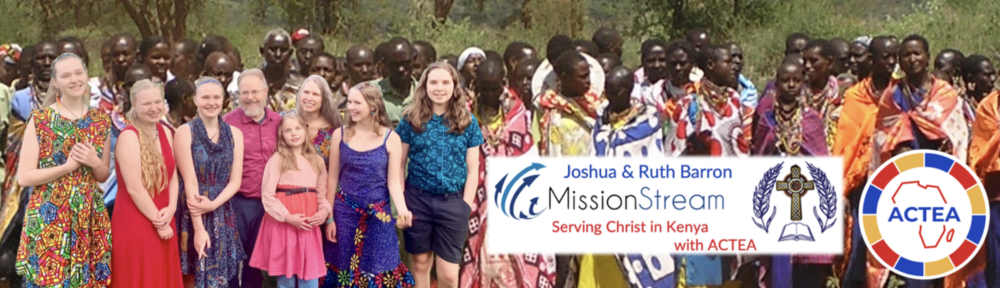
Here is something a little more academic than what I (Joshua) usually share here. But to teach in African contexts well, to properly train Maasai and Turkana church leaders (as well as church leaders from other ethno-cultural groups in Africa) to effectively fulfill their role in equipping the Church — making disciples of Africans in African contexts, baptizing them and teaching them to follow the Way of Jesus in all aspects of life — it is absolutely necessary to understand African cultures well. So here is reflection of some of the hard behind-the-scenes cross-cultural work in which we customarily engage.
(An earlier version of this was presented in an online PhD seminar, “TR 906 African Biblical and Theological Hermeneutics,” VID Specialized University, Stavanger, Norway, on 4 May 2021.)
Enkiteng Hermeneutics:
Reading the Bible with Maasai Christians
by Joshua Robert Barron
May 2021
Introduction
…..We all read, or listen to, scripture through a hermeneutical lens. All such lenses are necessarily tinged by culture. No reading of Scripture is acultural (Ukpong 1995, 6) and “none of us has a neutral perspective on … the Bible” (Mburu 2019, 22). Some practitioners of historical-critical methods of biblical interpretation are convinced that they are just reading scripture with all culture cut away. They are, of course, gravely mistaken and confused by their own cultural myopia. A healthy hermeneutic will not only explain, insofar as this is possible, what the text meant to the original recipients in their cultural contexts but will also engage with the cultures of contemporary recipients. Just as “a Theologia Africana which will seek to interpret Christ to the African in such a way that he feels at home in the new faith” (Sawyerr 1971, 240) is necessary for a healthy African Church, so healthy African hermeneutics require “African biblical scholars [who are] wary of running away from their African selves or identities and relying heavily on Western paradigms” (Masenya and Ramantswana 2015, 2). Gerald West notes that
Interpreting the biblical text is never, in African biblical hermeneutics, an end in itself. Biblical interpretation is always about changing the African context. This is what links ordinary African biblical interpretation and African biblical scholarship, a common commitment to interpret for contextual transformation. (West 2018, 248)
In the specific context of the Maasai people of East Africa, “while there are certainly areas where Maasai culture can benefit from Christian transformation, a recovery of traditional Maasai cultural values through a theologically robust process of inculturation can strengthen the Maasai churches as well” (Barron 2019, 17). This process will necessarily require a contextual African (Maasai) hermeneutic.
Ordinary Reader Hermeneutics is Vernacular
…..It is increasingly recognized within the discipline of African Biblical Hermeneutics that “both scholarly readers and the ordinary readers [are] capable hermeneuts” (Kĩnyua 2011, 2; see also West 1999, Elness-Hanson 2017, Lyimo-Mbowe 2020, Nkesela 2020). Ordinary readers, of course, are those who are not part of the scholarly guild or who otherwise lack training in interpreting biblical texts. As someone who is a scholarly reader with a commitment to equipping ordinary readers, I must ask myself whether “our biblical scholarship is committed more to our (elitist) peers than to people on the grassroots” (Masenya 2016, 4). It is also apparent that ordinary readers are most at home when approaching the biblical text in their own vernacular. Kwame Bediako saliently reminds us that “Mother tongues and new idioms are crucial for gaining fresh insights into the doctrine of Christ” (Bediako 1998, 111) — this is true not just for Christology but for biblical interpretation generally. As a foreign missionary myself, I remember that access to vernacular bible translations necessarily results in African hermeneutical agency as well as placing foreign missionaries in a subordinate position to the local Christians (Sanneh 2009, 196; West 2018, 245) — I am a partner of ordinary Maasai readers, but I am not in charge.
Enkiteng Hermeneutics?
…..After observing that “the Bible in African languages remains the most influential tool of rooting the Bible in African consciousness,” Masenya (Ngwan’a Mphahlele) and Ramantswana go on to note “the limitations of foregrounding the Bible as written word within aural contexts” (2015, 5) of Africa. These twin realities loomed large for my wife and me when we moved in 2007 to “the bush” of Maasai Land in southern Kenya in order to assist the local churches with curriculum development. Our work must be grounded in the Maa translation of Scripture and must take account of the importance of orality in Maa culture. The first matter at hand, of course, was to learn the Maa language. But eventually we had to begin writing curricula! We had previously taught at a small bible institute in South Africa (2000–2001). We had seen that simply transplanting western ways of thinking and studying simply wasn’t working. Pastors could be trained to preach a good sermon in English, but they weren’t being equipped to exegete Scripture in their own vernacular. (Of course, we’ve also seen American seminary grads who could pontificate doctrine but who couldn’t connect with the ordinary readers in the pews of their churches.) So we were committed to finding a different way. First of all, we knew that Maasai church leaders needed to teach in the Maa language and as Maasai Christians instead of just reproducing a British style lecture. What would that look like?
…..We learned that traditionally, the Maasai teach and engage in character formation through storytelling, parables, drama, and proverbs — and never through a western style lecture! This, of course, is common across much of Africa. Kĩnyua, an Agĩkũyũ biblical scholar from Kenya, proposes that scholarly readers and ordinary readers alike should “engage the Bible through the language of the African theatre and storytelling” (2011, 322). Why, we wondered, weren’t we seeing that in the local Maasai congregations? Why were Maasai Christians instead trying to imitate foreign models? We set out at once to learn as many traditional Maasai stories and proverbs as we could and to learn traditional Maasai modes of communication. Effective communication had to be appropriately contextual for the culture. This brings us to enkiteng.
…..Enkiteng is the Maa word for “cow.” Traditionally, the Maasai are semi-nomadic herdsfolk, raising cows, sheep, and goats. Culturally, cows are the most important animal. To be wealthy means to have cows and children. The Maasai will see the wealthiest world leader who has neither cows nor children as impoverished. The plural of enkiteng is inkishu. Interestingly, the Maa word for “life” is enkishui. This points to the integral and intimate connection in the worldview of the Maasai between cows and flourishing human life.
…..So when we were asked to teach an “inductive bible study” course at a local Discipleship Training School (in 2008), we started with a parable about cows. Cows, of course, are ruminants — they chew the cud. They don’t just swallow chunks of food down without chewing. They chew it thoroughly before swallowing. Later, they regurgitate the grasses they have eaten and chew the cud a second time. In that way they can extract all the goodness out of the grass — this is something elephants, for example, cannot do, as even a casual comparison of cow and elephant dung will reveal. Likewise, a good shepherd — the most common Maasai word is olchekut (for men) or enchekut (for women); it refers to a shepherd of livestock generally, not just of sheep — knows the importance of pasture rotation. Only grazing in one spot is bad for the pasture and eventually bad for the cows as well. Instead, it is necessary to migrate to new pastures to allow the grass to recover at the former one. In the same way, Christians should intake Scripture as the cow intakes grass, taking time to “chew the cud.” Similarly, Christians should “graze” throughout the whole of Scripture, not just from their favorite Gospel or Epistle. I should mention that “eating” or “chewing” is a common idiom in Maa. Where Hebrew speaks of “cutting a covenant,” Maa speaks of “eating an oath.” Traditional greetings include elaborate exchanges of “eating the news.” When you want to catch up with someone, you will invite them, mainosa ilomon! (“let’s eat the news!”);* the word ainos is one of the verbs for eating; enkinosata refers to the act of eating. Thus we speak of enkinosata Ororei le Nkai, “eating the Word of God,” anaa enkiteng nanyaal ing’amura, “as the cow chews the cuds.” We have developed this more fully in Maa elsewhere (e.g, Barron and Barron 2008, 27–28 and 48–57).
[*footnote: The Maa phrases meaning “eating the news,” using the verbs ainos or anya, are usually translated as “chewing the news” in English, though anyaal is the proper term for “to chew;” this is probably due to the influence of the English idiom of “chewing the fat.”]
…..That first course on Enkinosata Ororei le Nkai was so well received and proved so helpful that we developed it into a full curriculum which went to press in December 2008. The full title translates to “Eating the Word of God: Comprehending the Holy Bible: How You Can Really Listen to the Word of God in the Bible so that you grasp its meaning.” We wrote it with the understanding that the majority of the Maasai congregants in rural congregations were illiterate, especially among the older generations. Sometimes the teacher or preacher might be the only literate person in the gathering. (In other words, we took the African contextual reality of the importance of orality quite seriously.) After an introductory “instructions for teachers” which explains how to use the following lessons and demonstrates the importance of communicating in a Maasai fashion, there are ten lessons (though most Maasai teachers will take more than ten sessions to teach the material). All of the lessons are parable based, using parables which arise naturally out of Maa culture — just as the parables of Jesus rose naturally out of his surrounding cultural context — and include the frequent use of enkiguran (“drama”). We give examples of how one may, as a Maasai, “chew the cud” of the biblical texts in order to direct Maa cultural questions to Scripture. The Enkinosata book has since been translated/adapted for kiSwahili and NgaTurkana.
…..Charles Nyamati (a Tanzanian biblical scholar) taught that “the Christian has something to learn from the traditional African; not in the sense of new doctrines, but in the sense of new insights and new ways of understanding God” (1977, 57); I would add “new insights and new ways of understanding Scripture.” As we worked on the Enkinosata project and as I have continued to develop in my other research and teaching what I have here called an enkiteng hermeneutic, I have tried to encourage Maasai believers “to embrace and celebrate the use” of their Maa language in their biblical interpretations and in their theologizing and “to make full use both of Maa culture and language” in intersection with the Scripture as they build up the Church of Christ in Maasailand (Barron 2021b, 15). I hope that as a professional reader I thus have been able to join Maasai indigenous and ordinary readers of Scripture as “partners in an ethical way of relating the biblical texts to the context” (Nkesela 2020, 10).
Conclusion
…..Like Masenya and Ramastwana, I am convinced that
required to abandon their African optic lenses. Rather, it is through such lenses that they are called upon to contribute to the global intercultural theological or biblical hermeneutics table as equal partners. (Masenya and Ramantswana 2015, 3)
Through this enkiteng hermeneutics — an intercultural Maasai African Biblical hermeneutics — Maa culture and the cultural sensibilities of the ordinary readers among the Maasai people are privileged. This “encounter between the Maasai and the Bible provides conceptual tools for strengthening not only [Maasai culture] but also African culture and identity more generally” (Nkesala 2020, 194), enabling Maasai Christians to translate “biblical truth into [the] vernacular categories and worldview” (Shaw 2010, 167) “of the broader Maa culture” (Barron 2021a, 5). Masenya and Ramantswana correctly assert that “the survival of African Biblical Hermeneutics depends on African biblical scholars digging more wells from which Africans will quench their thirst” (Masenya and Ramantswana 2015, 11). Through enkiteng hermeneutics, I have seen numerous such new wells flow with the enkare namelok (“sweet water”) of new insights for Maasai Christianity (for some examples of possibilities of such new wells, see Barron 2019 and Barron 2021b; time does not permit me to share more).
……………………….
BIBLIOGRAPHY
Barron, Joshua Robert. 2021a. “Conversion or Proselytization? Being Maasai, Becoming Christian.” Global Missiology 18 (2): 12 pages.
NB: a PDF of the article is available at Global Missiology’s site.
Barron, Joshua Robert. 2021b. “My God is enkAi: A Reflection of Vernacular African Theology.” Journal of Language, Culture, and Religion 2 (1): 1–20.
NB: a PDF of the journal issue is available here.
Barron, Joshua Robert. 2019. “Lessons from Scripture for Maasai Christianity, Lessons from Maasai Culture for the Global Church.” Priscilla Papers 33 (2): 17–23.
NB: a PDF of the journal issue is available here.
Barron, Joshua [Robert] and Ruth Barron. 2008. Enkinosata Ororei Le Nkai: Enkibung’ata Bibilia Sinyati: Eninko Teninining Ororei le Nkai te Bibilia Nimbung Enkipirta enye: Inkiteng’enat Tomon. Nairobi: Community Christian Church.
Bediako, Kwame. 1998. “The Doctrine of Christ and the Significance of Vernacular Terminology.” International Bulletin of Missionary Research 22 (3): 110–111.
Elness-Hanson, Beth E. 2017. Generational Curses in the Pentateuch: An American and Maasai Intercultural Analysis. Bible and Theology in Africa 24. Edited by Knut Holter. New York: Peter Lang.
Kĩnyua, Johnson Kĩriakũ. 2011. Introducing Ordinary African Readers’ Hermeneutics: A Case Study of the Agĩkũyũ Encounter with the Bible. Religions and Discourse 54. Edited by James M. M. Francis. Oxford: Peter Lang.
Liew, Tat-siong Benny, ed. 2018. Present and Future of Biblical Studies: Celebrating 25 Years of Brill’s Biblical Interpretation. Leiden, Brill.
Lyimo-Mbowe, Hoyce Jacob. 2020. Maasai Women and the Old Testament: Towards an Emancipatory Reading. Bible and Theology in Africa 29. Edited by Knut Holter. New York: Peter Lang.
Masenya (ngwan’a Mphahlele), Madipoane. 2016. “Ruminating on Justin S. Ukpong’s inculturation hermeneutics and its implications for the study of African Biblical Hermeneutics today.” HTS Teologiese Studies/Theological Studies 72 (1): Article # 3343, 6 pages.
Madipoane Masenya (Ngwan’a Mphahlele) and Hulisani Ramantswana. 2015. “Anything new under the sun of African Biblical Hermeneutics in South African Old Testament Scholarship?: Incarnation, death and resurrection of the Word in Africa.” Verbum et Ecclesia 36 (1): Article #1353, 12 pages.
Mburu, Elizabeth. 2019. African Hermeneutics. Carlisle, England and Bukuru, Nigeria: HippoBooks.
Nkesela, Zephania Shila. 2020. A Maasai Encounter with the Bible: Nomadic Lifestyle as a Hermeneutic Question. Bible and Theology in Africa 30. Edited by Knut Holter. New York: Peter Lang.
Parratt, John, ed. 1997. A Reader in African Christian Theology. 2nd edition. International Study Guide 23. London: SPCK.
Sanneh, Lamin. 2009. Translating the Message: The Missionary Impact on Culture. 2nd edition, revised and expanded. American Missiology Society 13. Maryknoll, New York: Orbis Books, 2009.
Sawyerr, Harry. 1971. “What is African Christian Theology?” Africa Theological Journal 4: 7–24.
Shaw, Mark. 2010. Global Awakening: How 20th-Century Revivals Triggered a Christian Revolution. Downers Grove, Illinois: IVP Academic.
Sugirtharajah, R. S., ed. 1999. Vernacular Hermeneutics. The Bible and Postcolonialism 2. Sheffield, England: Sheffield Academic Press.
Ukpong, Justin S. 1995. “Rereading the Bible with African Eyes: Inculturation and Hermenetuics.” Journal of Theology for Southern Africa 91 (3): 3–14.
West, Gerald O. 2018. “African Biblical Scholarship as Post-Colonial, Tri-Polar, and a Site- of-Struggle.” In Present and Future of Biblical Studies: Celebrating 25 Years of Brill’s Biblical Interpretation, edited by Tat-siong Benny Liew, 240–273. Leiden, Brill.
West, Gerald O. 1999. “Local is Lekker, but Ubuntu is Best: Indigenous Reading Resources from a South African Perspective.” In Vernacular Hermeneutics, edited by R. S. Sugirtharajah, 37–51. Sheffield, England: Sheffield Academic Press.